Principles of Microeconomics · Lecture 6
In this lesson
Price Controls
A price does a job. At the market-clearing price, the amount people want to buy just matches the amount available; above it sellers cannot find enough buyers, below it buyers cannot find enough goods. The money on the tag is only part of what a trade costs, too. The full price of a thing is its money price plus all the nonmoney costs of completing the trade: the searching, the waiting, the hauling, the pulling of strings. Keep both ideas in view, because the story of this post is what happens to each when a law forbids the money price from settling where it would.
That story turns on one distinction. Scarcity, the permanent fact that our wants outrun what exists, never goes away. A shortage is the gap that opens when a price is pinned below where trade would otherwise clear, so the amount demanded exceeds the amount offered. A surplus is its mirror above clearing. In this post, both result from a binding legal price, not physical lack or plenty.
If a shortage is what happens when a price is forbidden to rise, and a surplus is what happens when it is forbidden to fall, what exactly do the laws that do the forbidding accomplish? This post follows the consequences for price ceilings, input caps, and price floors.
Figure focus. Required: rent ceiling and price floor. Others are references unless assigned.
A Price Ceiling Creates a Shortage and Shifts Competition to Other Forms
A price ceiling is a legal maximum: the price may not rise above it. Set below the clearing price, it creates a shortage, and that shortage sets off a cascade of effects, every one following from the same logic.
Start with rent control. Suppose demand for apartments rises because the city grows. In a free market the rent would rise to clear the larger demand against the fixed stock of apartments. A ceiling that pins the rent at its old level leaves the amount people want to rent far above the amount available, and the difference is the shortage. The apartments do not multiply to meet demand; the law has simply forbidden the price from doing its rationing.
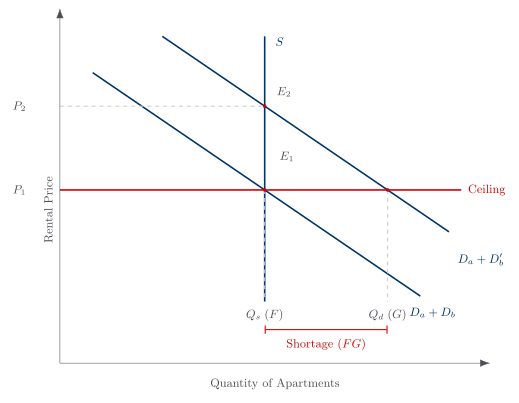
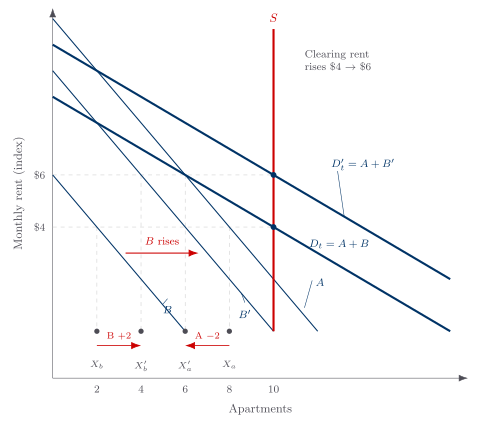
The incumbent tenant’s lease has acquired wealth even though the legal rent is low. If subleasing were freely salable, the tenant could charge the newcomer for the right to occupy the controlled apartment and collect roughly the gap between the controlled rent and the market rent. The ceiling would then be visible as a transfer to whoever happened to hold the lease when the rule took effect, rather than as a gift to tenants in general. That transparency is politically awkward, which helps explain why controlled leases are commonly restricted from being sold even though the hidden value remains.
So something else does the rationing, and here is the heart of it. A ceiling does not abolish the full price; it changes the form in which the full price is paid. Forbidden to compete by offering more money, buyers compete in every other way: they line up, wait, pull strings, offer side payments, befriend the landlord. The full price reappears as time in queues, as “key money” under the table, as the favoritism of whoever controls the good. The one appeal a buyer is forbidden to make under a ceiling is the very one that would clear the market, namely offering more money, so all the other appeals intensify.
These other forms of competition can consume value rather than transfer it. When waiting is merely a contest for an apartment, the tenant’s hours do not pass to the landlord as a payment; they displace work, study, or rest. A money payment is a transfer between buyer and seller, while wasted search and waiting use real resources. Queues can sometimes screen urgency or convey information, so their entire cost need not always be waste. In the baseline case here, however, the waiting serves only to rank equally eligible buyers. The lost value from such resource-using competition and from mutually beneficial trades the ceiling blocks is part of the control’s deadweight loss.
Worse, those other appeals reward traits that have nothing to do with willingness to pay. With money competition suppressed, a landlord choosing among a crowd of eager applicants can indulge any preference at no cost to himself, since the rent is the same whomever he picks. He can favor the applicant with the right looks, the right connections, no children, no pets. Every choice is in some sense an act of discrimination; choosing a television by its features rather than its price is still discriminating among options, and there is nothing sinister in the word itself. The point is which criterion gets to do the discriminating. A money price discriminates by willingness to pay; a ceiling hands that power to whichever nonmoney traits the seller favors, and the applicants richer in those traits get the housing while others are shut out. A law sold as helping the vulnerable can end up sorting against them.
The response can also appear in quality. A below-market rent weakens the owner’s return from some maintenance and improvement, while a waiting list reduces the reward for attracting tenants. Maintenance rules, enforcement, reputation, and long-run asset value can counter that incentive, so deterioration is a prediction to test rather than an automatic result.
A ceiling tends to produce all of these at once: the quantity demanded rises, the quantity supplied falls, quality deteriorates, black markets and side deals spring up, the little services that used to come with the good get stripped away, and the good is misallocated to lower-valued uses.
Tradable ration coupons show the same mechanism. Each buyer needs both money and a coupon, and transferable coupons acquire a price. Apart from transaction and enforcement costs, the controlled money price plus the coupon’s opportunity cost approaches the clearing price. The rule changes who initially receives the valuable claim, not the scarcity behind it.
Holding Down an Input Price Does Not Lower the Output Price
A tempting move during any “crisis” is to attack high consumer prices by capping the inputs that go into the product. If gasoline is dear, cap the price of crude oil; if meat is dear, cap the price of cattle. The move fails, and seeing why is one of the most useful things in this topic.
In the baseline case, Capping the price of an input does nothing to increase the supply of the finished good. If gasoline remains freely priced and the cap creates no additional output, cheaper crude does not lower gasoline’s clearing price; it creates a valuable margin for processors who obtain the controlled input. If the cap discourages extraction, gasoline supply can fall and its price can rise. Market power, contractual pass-through, inventories, or a simultaneous output-price control require separate analysis, but none makes an input cap create more physical output by itself.
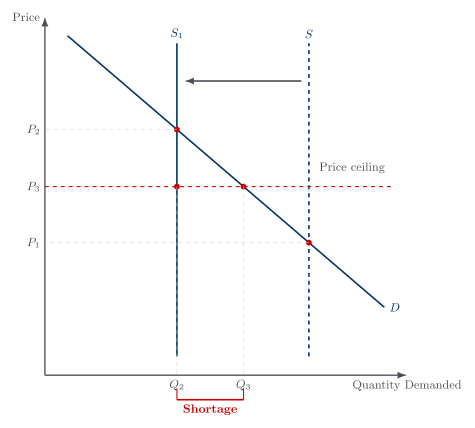
The deeper principle is joint determination. The demand for an input is derived from the value of the final product it helps make, while the input’s own supply also matters. Land suited to wine grapes commands more when demand for wine rises; if wine became worthless, that use would no longer support the same rent. Input prices then affect which techniques and quantities producers choose. It is therefore incomplete to say either “costs alone set prices” or “consumer demand alone sets costs”: demand for outputs, supply of inputs, substitution, and time interact.
That delay is an inventory buffer at work. Inventories can absorb a temporary demand change while posted prices stay stable; once the buffer is depleted, the price and replacement cost reveal the change. A chosen buffer or brief voluntary queue is therefore not the same thing as the persistent shortage created when law prevents the price from adjusting.
A Price Floor Creates a Surplus, and Sellers Compete It Away in Other Forms
The mirror image of a ceiling is a price floor, a legal minimum below which the price may not fall. In the competitive baseline the rule is simple. Set above the clearing price, it creates a surplus: the amount offered exceeds the amount demanded. Agricultural price supports are the classic example. A competitive labor-market model gives the same excess-supply prediction for a binding minimum wage; the later labor topic shows why employer wage-setting power can change the employment response.
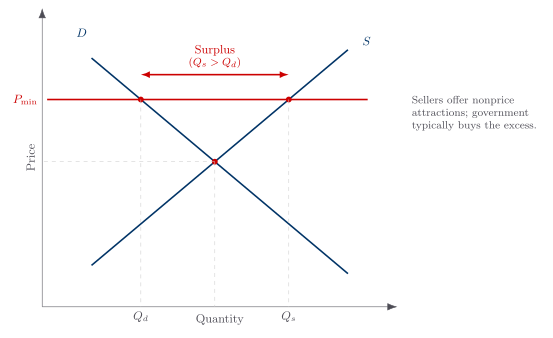
A government can reach a target floor price in two ways. It can shrink supply by paying producers to grow less, dragging the quantity down until the smaller amount fetches the higher price. Or it can pump up demand by buying the surplus itself at taxpayer expense. Either way the price stays above where it would otherwise settle, and either way the public pays, once at the register and again as a taxpayer.
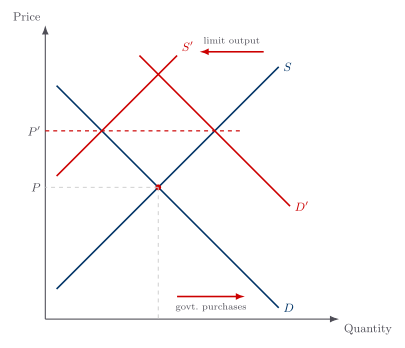
A floor leaves sellers unable to clear the market by cutting the money price, so, just as buyers did under a ceiling, they compete in other forms. They lavish extra services, amenities, and quality on the good to justify the high mandated price, dressing up the “full product” because they may not lower the price of the bare one. The surplus is resolved only by a lower price, by restricting output, or by someone, usually the government, buying and storing or destroying the excess.
Price Controls Persist Because They Hand Officials Power and Credit
If price controls do such damage, why are they so durable? The answer is political economy, and it ties this topic together.
One persistence mechanism is official discretion. The power to fix and enforce a price is the power to decide who gets the scarce good once money bids are constrained. A low posted price is also visible, while waiting, quality changes, and forgone trades are harder to observe. Those features can reward officials who defend a control. They do not establish anyone’s motive. Voters may knowingly prefer the distribution, incumbent beneficiaries may organize to preserve it, administrators may pursue stability or access, and supporters may dispute the predicted magnitude. Political economy identifies these incentives and asks which explanation fits the evidence.
Through all of it, keep the economist’s discipline in view: this is positive analysis, not a verdict. Scarcity always forces some form of competition. If competition by money price is suppressed, competition by force, by waiting, by connections, by political pull takes its place; the competition never stops, only its form changes. Economics can tell you what each form of competition will do, who will gain and who will bear the cost. It cannot tell you which scarce goods ought to be rationed by markets and which by some other rule. That choice rests on values you bring to it. What economics offers is the cause and effect, so that whatever you decide, you decide it with your eyes open.
For Further Reading
Want to explore the source material? This lecture draws on the following chapters from two books by Armen A. Alchian and William R. Allen:
- Universal Economics (Liberty Fund, 2018): Ch. 11, “Illustrative Applications of Demand Principles”; Ch. 12, “Shortages, Surpluses, and Prices”.
- Exchange and Production, 3rd ed. (Wadsworth, 1983): Ch. 4, “Market Prices as Social Coordinators”.
Key takeaways
- A binding ceiling creates a shortage; a binding floor creates a surplus. Neither abolishes the full price; each redirects competition, so compare transfers, resource-using search and waiting, blocked trades, quality changes, and any screening or distributional benefit.
- An input cap does not create more output. With a freely priced final good and no output increase, the cap creates a valuable processing margin rather than a lower clearing output price; derived demand and input supply jointly determine costs.
- Controls can create political constituencies. Official discretion, visible posted prices, incumbent benefits, distributional goals, and harder-to-observe costs can all support persistence; the mechanism alone does not establish which motive dominates.
- Ceiling, floor, full-price, coupon, input-control, and five-figure mechanisms remain.
- Queue waste and maintenance deterioration now state their maintained conditions.
- Input-cap objective uses the freely priced-output/no-output-increase baseline and joint determination; the minimum-wage preview points to T10b’s monopsony case.
- Political persistence compares official discretion, beneficiaries, distribution, and stability as evidence-tested mechanisms rather than an inferred motive.
- Three objectives, five Core and fourteen coverage anchors, and migration routing remain. —>
Lecture recaps
A summary of what we covered in each class session on this topic.