Principles of Microeconomics · Lecture 5
In this lesson
Markets and Coordination
A modern economy is a bewildering thing. Millions of people who never meet and never coordinate on purpose somehow produce, ship, and sell the food, fuel, and clothing each of the others wants, in roughly the right amounts and the right places, with no authority computing anyone’s share. No one plans how much bread to bake or where to send the milk, yet the groceries stay stocked. How do all those separate decisions add up to a working whole instead of chaos, and when goods do run short, what has gone wrong?
That is the puzzle this post takes up, and the answer runs through prices. Under enforceable rights, workable competition, usable information, and room to adjust, prices can guide separate decisions without anyone directing the whole. They signal scarcity, reward economizing and added supply, and allocate goods by willingness and ability to pay. This post builds that machinery, then marks its assumptions; the posts that follow ask what happens when a law forbids the price to move.
Trade Runs on the Full Price, Not Just the Money Price
As the previous post showed, informed voluntary trade makes both sides expect gains, realized when they understand the terms and each delivers as promised. Yet trade stops before every otherwise-beneficial swap because finding a partner, judging goods, haggling, hauling, and enforcing delivery all consume resources. Those transaction costs stop the remaining trades once their expected gains no longer cover the costs. So the full price of a thing is the money price plus all the nonmoney costs of completing the trade. A used car listed at five thousand dollars can cost considerably more once you add weekends spent searching, time arranging an inspection, and the risk of being cheated.
Middlemen exist to shrink these costs. A middleman stands between the original seller and final buyer: a wholesaler or broker can search, sort, and vouch at lower cost, raising the seller’s net while lowering the buyer’s full price. The cash spread between what he collects and pays compensates him for those services; profit is only what remains after his own real costs.
The table below traces the gain for a single egg. Without a middleman, the buyer pays eight cents in cash plus a penny of his own trouble, a full price of nine cents; the seller collects eight cents but bears half a cent of selling costs, netting seven and a half. A specialist handles the messy parts. Now the buyer pays eight and a half cents in cash but nothing in extra trouble, and the seller nets seven and three-quarter cents. The buyer’s full price falls and the seller’s take rises, even though the cash price the buyer hands over goes up.
| Buying one egg | Money | Nonmoney | Full price |
|---|---|---|---|
| Without a middleman | |||
| Buyer pays | 8.0¢ | 1.0¢ | 9.0¢ (paid) |
| Seller gets | 8.0¢ | 0.5¢ | 7.5¢ (received) |
| total do-it-yourself cost | 1.5¢ | ||
| With a middleman | |||
| Buyer pays | 8.5¢ | 0 | 8.5¢ (paid) |
| Seller gets | 7.75¢ | 0 | 7.75¢ (received) |
| specialized service cost | 0.75¢ |
The three-quarter-cent spread pays for the intermediary’s service, which this example treats as a real cost rather than pure profit. It replaces 1.5 cents of do-it-yourself costs: the buyer saves half a cent and the seller gains a quarter-cent. That is why “buy direct and eliminate the middleman’s cost” is usually a confusion.
A discount store boasts that it “cuts out the middleman” so you save, but eliminating the middleman does not eliminate the work he was doing; it just hands that work back to you. Do it yourself, and the cost has not vanished, only changed hands. Sometimes doing it yourself is cheaper; often the specialist is, which is why he has a business.
Open Markets Have Free Entry; Closed Markets Are Walled Off
A market is open when anyone may enter it to buy or sell, with no contrived barriers blocking the way. In this analytic sense, general rules against fraud, unsafe conduct, or rights violations need not make entry closed if they are applied without protecting selected incumbents. A market becomes more closed as selective force, collusion, or law excludes otherwise qualified buyers or sellers.
Licensing, certification, product rules, and sales restrictions all raise entry costs and can protect incumbents. They can also reduce fraud, supply information, protect third parties, or enforce quality when those benefits are real and the rule is well targeted. The economic question is not whether a rule has a reassuring label, but whether its marginal benefit exceeds its entry, compliance, enforcement, and political costs compared with feasible alternatives.
An open market presumes a few things we rarely notice: that people are legally free to make the trade, that private property rights exist so what is traded is actually yours to sell and stays yours after you buy it, and that people are looking to improve their situation. Strip away any of these and the market stops working as one.
Restricting Entry Transfers Wealth; It Does Not Create It
Why would anyone try to close a market? Protection from competition can be valuable. An exclusive taxi license may raise the holder’s earnings, so firms lobby, donate, and campaign for the privilege. Economists call spending real resources to obtain a government-granted advantage rather than to produce something rent-seeking. In the pure transfer case, the effort uses resources without creating the service consumers sought. Advocacy can also convey information or improve a rule, so the classification depends on what the activity changes, not merely on contact with government.
Suppose a city grants one company the exclusive right to sell liquor and a politician favors a campaign supporter. If the restriction raises price and blocks mutually beneficial trades without an offsetting benefit, consumers and excluded rivals lose more than the firm gains. Concentrated gains can make beneficiaries easier to organize than dispersed consumers, but organization, salience, institutions, ideology, and countervailing groups determine whether that advantage wins. This concentrated-versus-dispersed mechanism returns across the course as a hypothesis to test, not a motive or outcome to assume.
A confusion runs through the politics of protection. Freedom of competition means open entry: anyone may try to win customers. Freedom from competition means protection against rivals. In the benchmark with no corrective benefit, the first opens additional gains from trade while the second transfers a slice to insiders and destroys some trades. A real rule still has to be compared with fraud, safety, information, enforcement, and other institutional alternatives rather than judged from its title alone.
Prices Coordinate an Economy No One Is Running
Return now to the puzzle of coordination. An unplanned economy can coordinate through prices because they are an ordered set of signals and rewards, and they do their work without anyone intending it. The mechanism is powerful, not infallible: market power, missing rights, spillovers, bad information, adjustment costs, and legal constraints can distort the signal or the response.
A price is a signal: it summarizes many competing demands and the available supply in one number. It does not reveal by itself which condition changed, but a pileup tends to lower the price and stronger competition for what is available tends to raise it, spreading the message without a memo.
A price is also a reward. A higher price restrains what buyers ask for and, when output can respond, gives suppliers revenue and reason to provide more. If a scarce input is free to a user who bears none of its opportunity cost, overuse is likely unless budgets, norms, quotas, monitoring, or other rules supply discipline.
And a price rations, steering each scarce good toward whoever will give up the most for it given current wealth, rights, and access. That is an allocation rule, not proof of greatest need or moral worth. The rationing runs in every direction because one seller’s price becomes the next producer’s cost: a change in beef demand ripples through a chain of input and output prices.
Demand and supply help explain how a scarce resource gets parceled among rival uses. In opportunity-cost terms, its value elsewhere affects what must be paid to draw it away. This is not yet a firm’s supply curve, which a later session derives from marginal cost. Every allocation system uses criteria. Under private property and open markets, willingness and ability to pay do much of the rationing; suppress money competition and connections, queues, persuasion, lotteries, eligibility rules, or political discretion may replace it. Compare those criteria by information, incentives, distribution, transaction and enforcement costs, spillovers, and error correction.
A Market-Clearing Price Balances What Buyers Want With What Is Available
In the benchmark with informed traders, enforceable exchange, responsive bids, and no binding control, competition presses price toward the level where quantity demanded equals quantity available or supplied. Search costs, sticky prices, market power, and adjustment can delay or alter that path. The matching level is the market-clearing price, or equilibrium price. In the fixed-stock car model, only that price makes desired holdings equal the stock.
To see where that price comes from, build market demand, which is just the sum of every individual’s demand at each price. The table below imagines a society of four people, A through D, and seven cars. Each person, at each possible price, wants to own some number of cars; add those across all four and you get the market demand in the right-hand column.
| Price | A wants | B wants | C wants | D wants | Market demand |
|---|---|---|---|---|---|
| $10,000 | 1 | 0 | 1 | 1 | 3 |
| $9,000 | 1 | 1 | 1 | 2 | 5 |
| $8,000 | 2 | 1 | 1 | 2 | 6 |
| $7,000 | 2 | 1 | 2 | 2 | 7 (clears) |
| $6,000 | 2 | 2 | 2 | 2 | 8 |
| $5,000 | 2 | 2 | 2 | 2 | 8 |
| $4,000 | 2 | 2 | 2 | 3 | 9 |
| $3,000 | 3 | 2 | 2 | 3 | 10 |
| $2,000 | 3 | 3 | 2 | 3 | 11 |
| $1,000 | 4 | 4 | 2 | 4 | 14 |
Market demand is the sum of the four individual demands at each price. With seven cars to go around, the market clears at $7,000, where the total wanted exactly equals the total available.
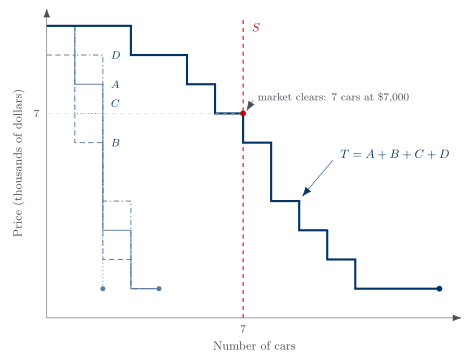
Two lessons fall out of this table. First, the price settles where the quantity demanded equals the quantity available: with seven cars, the clearing price is $7,000, the row where market demand reads seven. If demand rose, the clearing price would rise too; press “A new buyer joins” to watch buyer E shift the staircase right so the same seven cars re-clear at $8,000. Second, in this stripped-down model, the cars reach the same final owners no matter who starts with them. That result assumes informed voluntary trade, enforceable ownership, negligible transaction costs, and transfers too small to shift demand through a wealth effect. Under those assumptions, each person buys while another car is worth more than its price and sells when it is worth less. The initial allocation does not determine the final allocation.
At this stage, read the vertical line S as the total stock available to be held, not as a firm’s supply curve. Current owners’ willingness to keep or release cars is already included in their individual demands to own. A later session derives each firm’s supply from marginal cost.
Two smaller points sharpen the picture. “The price” of a car means the price actually agreed to in real transactions, not the sticker on the windshield or the optimistic figure in an ad. And the law that people buy more at a lower price than at a higher one, holding other relevant conditions fixed, is more dependable than any particular market outcome. A legal ceiling can prevent price adjustment from clearing a market, but it cannot repeal people’s response to price. The law of demand remains in force while the market-clearing result is blocked.
A Higher Price Rations Even a Supply That Cannot Grow
Even when not one extra unit can be made, a higher price still performs its rationing job: it steers the existing stock toward higher willingness and ability to pay and away from uses whose holders will sell. Under the model’s assumptions this exhausts additional measured gains from trade. It does not settle whether the resulting distribution is fair or whether a feasible nonprice rule would serve a stated objective better.
Bring back the seven cars. Suppose one is destroyed, so six remain and none can be built. At the old price more cars are wanted than exist, and bidding raises the price. Press “A car burns”: the unchanged demand staircase meets the six-car stock at $8,000. Forbidding the rise does not undo the fire. It creates excess demand at the controlled price, and luck, lines, priority rules, or discretion must allocate the cars. Such a rule may deliberately favor a target group, but its distribution, search costs, evasion, enforcement, and lost trades must be compared with price rationing rather than assumed away.
A Shortage Is Not Scarcity, and a Surplus Is Not Abundance
We need three words kept apart, because newspapers and politicians blur them constantly.
Scarcity is the condition we met on day one: less exists than people would want at a price of zero, and it never goes away. A reduction in supply is a physical fall in the amount available, as when a crop fails or a fire destroys housing. A shortage is the gap that persists when a price is held below clearing, so the amount demanded exceeds the amount offered. In the legal-control case studied here, it is a price phenomenon, not a physical fact, and it is created by a law, not by nature. A temporary stockout while prices or inventories adjust need not be this persistent controlled shortage.
A reduction in supply and a shortage come apart in both directions. The fire that cut the stock to six was a real reduction in supply, yet it produced no shortage, because the price was free to rise. And had the supply instead risen to nine, a price pinned below where nine would clear (the figure’s “Two cars arrive” scenario puts that clearing price at $4,000) would still produce a shortage, with more cars wanted at that low price than exist. What makes the persistent shortage in this example is not the stock’s size but the law holding price below clearing.
The controlled surplus is the mirror image: the gap that persists when a price is held above the clearing level, so the amount offered exceeds the amount anyone will buy. It is not physical abundance, and it can sit alongside real want because a floor keeps the price too high for the market to clear.
For Further Reading
Want to explore the source material? This lecture draws on the following chapters from two books by Armen A. Alchian and William R. Allen:
- Universal Economics (Liberty Fund, 2018): Ch. 6, “The Extent of Exchange”; Ch. 10, “Markets and Prices as Social Coordinators”; Ch. 11, “Illustrative Applications of Demand Principles”; Ch. 25, “Dependency Assurance by Reputation and Predictable Price”.
- Exchange and Production, 3rd ed. (Wadsworth, 1983): Ch. 4, “Market Prices as Social Coordinators”; Ch. 5, “Information Costs and Achievement of Exchanges”.
Key takeaways
- Trade runs on the full price. The full price is the money price plus every nonmoney cost of completing a trade, and a middleman can be paid for shrinking those costs, raising the seller's net while lowering the buyer's full price; his profit is what remains after his own real costs.
- Entry restrictions can transfer wealth and invite rent-seeking. An open market has free entry, while selective restrictions can protect insiders; judge a rule's information, safety, and enforcement benefits against its entry, compliance, political, and lost-trade costs rather than inferring its effect from its label.
- Prices coordinate under identifiable conditions. They act as signals, rewards, and a willingness-and-ability-to-pay allocation rule; market demand is the horizontal sum of individual demands, and the clearing price matches a fixed stock under the model's assumptions. This mechanism does not settle fairness, and a controlled shortage or surplus is not physical scarcity.
Lecture recaps
A summary of what we covered in each class session on this topic.