Principles of Microeconomics · Lecture 1
In this lesson
The Economic Way of Thinking
Most people assume economics is about money, the stock market, or getting rich. It has something to say about each of these, but it is really a way of thinking about the world, a small set of tools you will keep using long after you graduate: when you read the news, make your own decisions, or weigh a claim about how the world ought to work.
This course follows three problems. First comes reallocation: who gets existing goods and what gains arise from exchange? Next comes production and organization: how are more goods created, and by whom? Finally come income, time, and uncertainty: who is paid, when, and for bearing what? Throughout, ask what is scarce, what rule allocates it, what margin changes, and who bears the residual after people adapt. We begin with demand because exchange requires knowing what one more unit is worth.
Economics Is About Scarce Resources, Not Money
Economics begins with a stubborn fact: there are never enough resources to give everyone everything they want. That shortfall is not a problem we will eventually solve; it is a permanent part of the human condition. Because resources are scarce, every society must decide what to produce, how to produce it, and who receives it. Different societies answer these questions differently; a market economy answers them largely through prices, property rights, and exchange.
Economics is how we reason about those questions:
Whatever you enjoy, you got it through some effort, and however much you get, you find you want still more. Two things stand between you and everything you want: the limited stock of goods that actually exists, and everyone else who wants those same goods. And because any resource you put to one use is a resource you cannot put to another, using a scarce thing always means giving up the other things it could have done instead.
Money appears nowhere in that definition. Scarcity would press on us even in a world with no money at all: wherever there is not enough of something to go around and someone has to decide who gets it, an economic problem is present, whether or not a single dollar changes hands.
Scarcity Is Permanent, So Trade-offs Are Unavoidable
Scarcity is not unique to any society, nor the result of producing the “wrong” things: human wants outrun any quantity of means, and rearranging what we produce does not make the shortfall disappear. Nor is it a problem only for the poor: people rich by the standards of almost any earlier century still run up against wants that outstrip their means. Scarcity is the gap between what people want and what there is, not a matter of how much anyone happens to have.
Picture the alternative: the Garden of Eden, where everything anyone could want is simply there for the taking. Such a place would have production and consumption, but no economy, because no one would ever have to choose.
An economic good is scarce enough that getting more means giving something up; the word “good” carries no seal of approval: tobacco is an economic good even to a nonsmoker. A free good is so abundant nobody wants more even at a price of zero, and those are rare: ordinary air is the usual example, until you are a scuba diver or live in a smog-choked city.
A price tag of $0 does not make something free. “Free” parking, “free” beaches, and “free” tuition still use resources every bit as scarce and costly as anything you pay for, and handing a scarce thing out at no charge usually makes its scarcity bite harder, since nothing restrains how much people take. Somebody still pays, in time spent waiting or in taxes. At a $0 price scarcity does not disappear; only the rule for deciding who gets the scarce thing changes.
Every Society Needs a Rule for Who Gets What
A campus has 5,000 students and 2,000 parking spaces. Some students will get a space and some will not. This is not a policy choice but a matter of arithmetic, so the campus needs a rule for deciding who.
Because scarce things cannot satisfy everyone who wants them, people compete for them in every society: competition comes from scarcity itself and would exist with no money, prices, or markets at all. The only thing open to choice is the form competition takes: brute force, political power (whoever the state favors), authority (a committee’s judgment), first-come-first-served, or exchange (whoever pays). Political power matters because the state claims distinctive authority to make and enforce rules. Custom, arbitration, contract, and reputation also settle disputes; their performance depends on information, enforcement, and exit.
Every rule on this list discriminates in the plain sense: each picks who gets the scarce thing by some attribute, whether willingness to pay, arrival time, or a committee’s favor. Scarcity makes that unavoidable; the objection is to discrimination by race or religion, not discrimination itself. Every rule also carries a real cost, even the ones that look free: first-come-first-served costs you time; a “most deserving” committee costs you the effort of proving you qualify. No method escapes cost; the rules just change who pays and how.
Which forms of competition are even allowed shifts from one arena to another. A business competes with a better product at a lower price; a political candidate can instead promise to use the state’s power over other people’s wealth, raising taxes on some and cutting them for others. Noticing which tactic is allowed tells you a lot about how a prize is really won.
The rule in force also depends on who controls the scarce thing. A private garage rations parking by charging money, since the owner keeps what drivers pay; a public university rations admission by grades and test scores instead, since no administrator personally pockets a higher bidder’s tuition. Whenever you see a scarce thing handed out, ask which rule is running and what it costs people.
This course mostly studies one of these rules: exchange, competitive and cooperative at once. In an open market where buyers can walk away and sellers bear the relevant costs, rivals bid for business with lower prices, better products, or more convenience. A deal closes only when both sides expect to gain. Later topics examine what changes when information is poor, entry or exit is restricted, or costs fall on outsiders.
Every Choice Has a Cost
Every choice closes off the things you did not pick, and the most valuable of those is the real cost of what you choose: its opportunity cost. Money may not enter into it at all.
Ask yourself what it costs to go to college. The first answer that comes to mind is the money price: tuition, fees, books. But instead of sitting in class, you could be working full-time. That forgone paycheck never appears on a tuition bill, yet it is part of what college costs you, often the largest part.
Split the cost of a choice into two components. An explicit cost is one you pay out in money; an implicit cost is a value you give up without any payment changing hands. Tuition is an explicit cost of college, the earnings you give up while enrolled are an implicit cost, and the two together are the full cost. Implicit costs are easy to overlook: Joe runs his repair shop out of a building he already owns, so he writes no rent check, but still bears a real cost, since he could have leased that building to someone else.
A few features of cost regularly trip people up.
- Cost is personal. It is measured against whatever you yourself would otherwise have done, so your cost and your roommate’s for the same choice can differ.
- Cost looks forward. Resources already spent are a sunk cost: nothing you choose now can bring them back, so they are not a cost of any option in front of you. Twenty hours poured into a term paper that is not working are gone whether you push on or start over; the only live question is which move is best from here.
- Cost includes time. Spend an hour shopping to save three dollars when that hour was worth ten to you, and you have come out behind.
The unpleasant byproducts of a choice are not part of its cost. A sore arm is a consequence of playing tennis, not a cost of it, though a bad side effect can still weigh on whether you play.
One last idea, where our work on demand will begin: the more of something you already have, the less you will give up to get one more unit of it. To someone dying of thirst, the first glass of water is worth almost anything; by the fifth glass, it is worth very little.
Productive Efficiency Means No Waste
People throw around “efficient” as if it meant “produce as much as possible.” Take two goods, food and clean air, and trace out the largest combinations of them an economy’s resources could produce. That boundary line is the production possibilities frontier. Any point on the frontier is efficient: the only way to get more of one good is to give up some of the other. In this production setting, the precise term is productively efficient. Any point inside is wasteful, since you could have more of both at once. Productive efficiency means no waste: being on the frontier, not having the most of any single thing.
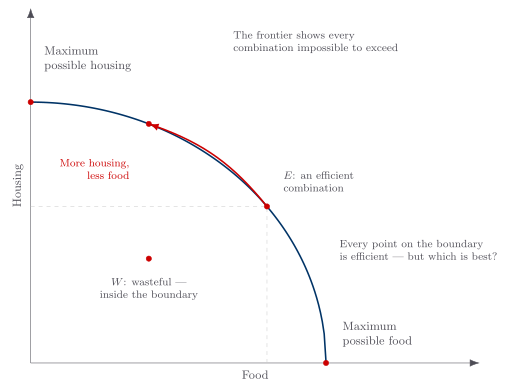
“Maximize one good” is an incoherent goal: grow nothing but food and the air turns to smog; shut down for clean air and you breathe beautifully with nothing to eat. People want some workable combination, and the frontier shows every productively efficient combination and its trade-off.
How far out the frontier sits is not fixed. Better tools and technology can push it outward, so a society can have more food and more clean air at once; that outward shift is economic growth, the old trade-off growing less severe. Scarcity does not vanish: the new frontier still bounds what is possible, and every point on it still forces a choice.
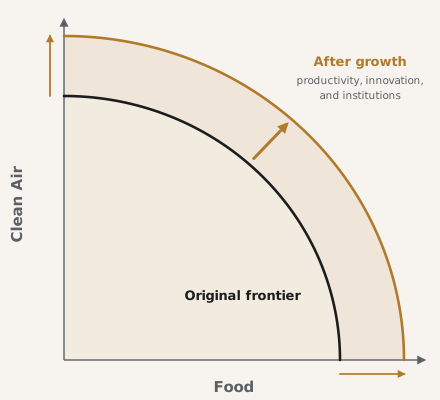
Productivity pushes the frontier outward. Resources matter, but so do knowledge, complementary inputs, public goods, secure claims, enforceable agreements, and room to experiment. Economics links these conditions to investment and production; their relative empirical importance must be investigated.
Being on the frontier still does not tell you which point is best. You might trade food for cleaner air while I trade the other way, and productive efficiency alone cannot crown a winner. It is a no-waste test about production, not a verdict about what is good. Later we will use Pareto efficiency, also called Pareto-optimality, for a different no-waste test about allocation: whether goods can be rearranged to make someone better off without making anyone worse off. Neither concept tells us which efficient outcome is best.
Economics Traces Cause and Effect
Economics is a science: a careful effort to work out what actually happens when a price rises, a law passes, or a new opportunity opens up. The emphasis is on cause and effect, not right or wrong.
The goal is to say what will follow from a given cause, stated plainly enough that the world could prove you wrong. A claim that a policy “might” help or “could” backfire is close to empty, because it rules nothing out. A useful claim says what will happen, or at least what becomes more or less likely: a legal cap on rents, for instance, raises the odds of a housing shortage. That is a refutable prediction, and once you have one you can check it against the evidence instead of arguing about what anyone meant to do.
None of this depends on the outcome being one you like. Tracing cause and effect can show that a policy meant to help ends up hurting, or that a measure that sounds harsh ends up doing good; the analysis reports what follows, and leaves the approving or condemning to you.
Good Theories Are Useful, Not Perfect
Economists reason with theories, and a theory is just a machine for getting from “if this happens” to “then this follows.” The question is not whether a theory is true, since none is perfect or complete, but whether it is useful: does it predict well enough, and cheaply enough, for the job at hand? A theory is like a map, leaving things out on purpose, and you would choose a different map for driving than for hiking. And for a theory to be useful its predictions must be refutable: stated so that evidence could prove them wrong.
Students often object that people are not as rational as economists assume. True, but the theory does not need them to be; we are after regularities in how people respond when their options change, the way water runs downhill even though no molecule chooses where to go. Broad regularities like the law of demand survive even when individuals behave erratically. A related objection confuses a theory that hangs together with one that works: a theory can be flawlessly logical and predict badly, or rest on cartoonish assumptions and predict accurately. The test that counts is not whether its parts are internally consistent but whether its predictions survive contact with the real world.
Economics Tells You What Is, Not What Should Be
Economists split claims into two kinds, positive and normative. A positive claim is about what is, or what will happen if we do something; a normative claim is about what should be. Economics is a positive, if-this-then-that tool: it can tell you the likely consequences of a tax or a rent-control law, but not whether those consequences are good. The “should” is yours to supply, once you have seen the “is.”
Be wary of words that smuggle a “should” inside what sounds like fact, like “fair,” “equal,” and “socially preferred.” “Fair” does not have to mean “equal,” and “what society prefers” quietly assumes a group can prefer things, when only individuals do the preferring.
Be on guard here against economists themselves, myself included: against presenting a value judgment as if it followed from a model. Economic training can sharpen a prediction about tariffs or minimum wages. Advice to adopt a policy also requires a criterion for judging efficiency, distribution, rights, risk, and error. Expertise can inform both facts and feasible trade-offs; it cannot silently choose the weights you place on them.
Economics Clarifies Your Trade-offs; It Doesn’t Supply Your Values
The same positive footing marks a limit on what economics can do for you. It can lay out what pursuing one thing you care about will cost you in terms of the others, but it holds no scale for weighing those things against each other. Economics contains no basis for calling a result good or bad; that verdict is yours to add once you have seen the trade-off. What the analysis insists on is only that the trade-off is real: there are no costless fixes, and refusing to weigh one does not make it vanish; it just settles the choice by default, on whatever terms circumstances impose.
Only Individuals Choose
Only individuals choose, and that fact underlies almost everything we do this term. “The government,” “the firm,” and “the market” have no minds or goals of their own. The people inside them do. Yet institutions matter because voting rules, contracts, authority, norms, and prices combine individual choices into outcomes no one person may have intended. Methodological individualism asks us to explain those rules and incentives rather than treating an organization as a single unexplained chooser.
That is why we keep pushing explanations down to individuals. To understand why “the government” or “a business” does something, we ask what the people inside are rewarded and punished for doing, whether in a market, a political office, or any other setting. That question is the hinge between economics and politics, and we lean on it all term.
Markets Rest on Property Rights and Voluntary Exchange
One caricature of economics is worth correcting: it does not assume everyone is selfish, only that people pursue their own interests, which can easily include the well-being of others. Self-interest is not selfishness; it just means having goals and acting on them.
Self-interested strangers still cooperate, mostly through voluntary exchange. Nobody can force a trade, so either side can walk away: my only move is to offer something you value more than what you give up, or you say no. A trade happens only when both sides expect to gain (positive-sum), and the walk-away option flips self-interest on its head: the only way I can get what I want from you is to serve you first. As Adam Smith put it in 1776:
It is not from the benevolence of the butcher, the brewer, or the baker, that we expect our dinner, but from their regard to their own interest.
Smith’s point is about motivation: what gets the butcher to cut meat for you is not kindness but his own livelihood. A related puzzle is about knowledge: even a simple product, a wooden pencil, say, draws on knowledge scattered across thousands of people. The logger who cut its wood need not know how to mine its graphite, or that you exist; prices pull that scattered knowledge together.
None of this works without property rights. Owning something means holding three powers at once: the right to use it, to sell or transfer it, and to keep what it earns or absorb what it loses. Strip away any one and you gut the ownership. A “right” here is not personal muscle; it is a claim your community recognizes and enforces.
Your rights protect the physical thing you own, not its market value: if a better taco stand opens across the street and your sales fall, nothing that was yours has been taken; that is just competition. “Free speech” works the same way, letting you address willing listeners with your own resources, never letting you commandeer someone else’s megaphone.
The gap between “capitalist” and “socialist” is not whether property rights exist (even the Soviet Union let people own clothes and furniture) but how far private rights extend over productive resources: the factories, farmland, and machines used to make things for others. A fully socialist economy has the state, not any private individual, holding those three powers over productive property; that is what “abolishing private property” means, not that no one can own a toothbrush.
Real economies combine private, common, nonprofit, and governmental rights, and no system fits one pure label. Transferable residual claims can strengthen incentives to invest, maintain, and adapt. Other arrangements may be chosen for public goods, external effects, distribution, mission, or enforcement reasons. The comparison is not a contest of labels; it asks how each arrangement performs on information, incentives, transaction costs, inclusion, and correction of mistakes.
Property claims are held by people, so calling a dispute “human rights versus property rights” can hide the actual conflict among people. A housing rule may protect a tenant’s security while limiting an owner’s control, and law may recognize additional duties or claims on either side. Clear analysis identifies whose use, transfer, income, security, and legal standing change; the normative decision then weighs those interests openly.
For Further Reading
Want to explore the source material? This lecture draws on the following chapters from two books by Armen A. Alchian and William R. Allen:
- Universal Economics (Liberty Fund, 2018): Ch. 1, “Welcome to Economics”; Ch. 2, “Your Economic Society”; Ch. 3, “Choice and Cost”.
- Exchange and Production, 3rd ed. (Wadsworth, 1983): Ch. 1, “Scarcity, Competition, and Social Control”; Ch. 3, “Exchange”.
Key takeaways
- Scarcity forces trade-offs. Every choice has an opportunity cost, counted in full (explicit plus implicit, not just money), sunk costs are irrelevant, and a $0 price does not mean free; the production possibilities frontier pictures productive efficiency (no waste) and growth (the frontier shifting out).
- Economics is positive, not normative. State refutable if–then predictions and judge a theory by whether its predictions survive testing against evidence; keep what is separate from what should be, the "should" being a value judgment you supply.
- Only individuals choose, and voluntary exchange is positive-sum: it rests on property rights, and both sides expect to gain, or the trade does not happen.
- Added the compact three-arc roadmap; no new assessed objective.
- Qualified broad court/informal-order, productivity, system, and rights comparisons.
- Open-market exchange now states exit and internalized-cost conditions.
- Methodological individualism now includes institutional filters and unintended outcomes.
- Three objectives, eleven Core and nineteen coverage anchors, figures, and budget remain. —>
Lecture recaps
A summary of what we covered in each class session on this topic.